TL;DR
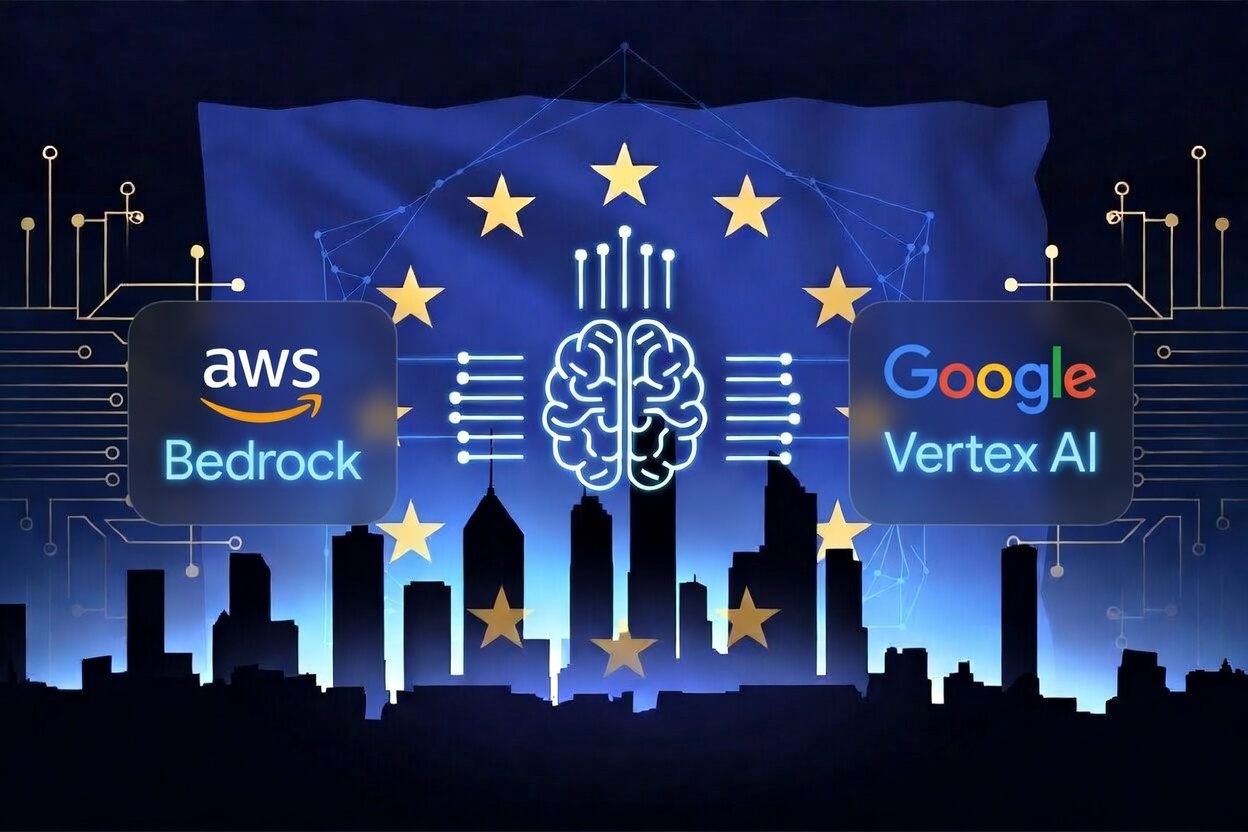
- •Claude runs on AWS Frankfurt (Bedrock) and Google Vertex AI EU — your data never leaves the EU
- •Gemini is also available on Vertex AI with EU data residency — same compliance guarantees
- •The API costs under €80/month to run 100 personalised prospects per day
- •A junior SDR in Germany costs €3,500–4,500/month — and still works on wrong signals 30% of the time
"We'd love to automate our prospecting, but we can't send client data to an American AI company. Legal won't allow it."
I hear this every week. You're based in Germany, France, or the Netherlands. Your clients are companies. The data you process — contact names, company information, email addresses — falls under GDPR. Sending that through a US-hosted AI raises questions your DPO will not enjoy answering.
Here's what most people don't know: that objection no longer holds. You have two solid EU-hosted paths.
Option 1: Claude on Amazon Bedrock — Frankfurt
Amazon Web Services runs Claude (Anthropic's AI) through a service called Bedrock. Bedrock is available in eu-central-1 — Frankfurt. What that means in practice:
- •Every API call stays within the EU region
- •Your data is processed on EU infrastructure, subject to EU law
- •Anthropic does not train its models on your data — covered explicitly in their Data Processing Agreement
- •Same Claude that handles legal document analysis, sales sequences, and research — just EU-hosted
Setup: AWS account → enable Bedrock in eu-central-1 → request Claude model access (usually instant) → create IAM credentials → connect to n8n or your code. Total time for a technical person: under 2 hours. n8n has a native Bedrock node — no custom API integration needed. Use n8n, not Make.com — n8n can be self-hosted in the EU (Hetzner, €4.50/month), giving you full control over where your workflow data lives. Make.com is US-hosted with limited EU data residency options.
Option 2: Claude or Gemini on Google Vertex AI — EU Regions
Google Cloud's Vertex AI platform is the other strong option — and it gives you two models worth considering.
Claude is available on Vertex AI through the Anthropic partnership, running in EU regions (europe-west3 in Frankfurt, europe-west4 in the Netherlands). Same model, same compliance, different cloud provider. If your team already runs on Google Cloud, this is the easier path.
Gemini — Google's own model — is also available on Vertex AI with EU data residency. Gemini 1.5 Pro and Gemini 1.5 Flash both run in EU regions and are covered by Google's Data Processing Addendum. For certain tasks — long document analysis, multimodal work, very large context windows — Gemini is worth having in the toolkit.
- •Google Cloud account → enable Vertex AI → select EU region (europe-west3 Frankfurt or europe-west4 Netherlands)
- •Request model access for Claude (via Model Garden) or Gemini (available by default)
- •Connect via Google Cloud SDK, n8n's Vertex AI node, or LangChain
- •Covered by Google's Cloud Data Processing Addendum under GDPR
Which one to use? If you're already on AWS: Bedrock. If you're on Google Cloud: Vertex AI. If you want both Claude and Gemini available: Vertex AI gives you both in one place.
What You Can Automate — With Full Compliance
Once the API is live (either path), here's what a typical system looks like:
- •Signal monitoring — funding announcements, job postings, tech stack changes tracked overnight, qualified prospects in your CRM by morning
- •Prospect briefs — full company context, decision-maker map, recent news, tech stack, risk flags. Built in under 60 seconds per prospect.
- •Personalised outreach — not a template. A message tied to the specific trigger that fired: a new hire, a funding round, a competitor churn signal.
- •Post-call automation — action items captured, follow-up drafted, CRM updated. Your rep closes. The agent handles everything after.
All of it running in the EU. All of it GDPR-compliant.
The Numbers — What This Actually Costs
Claude 3.5 Sonnet on Bedrock costs approximately $3 per million input tokens and $15 per million output tokens. For a typical prospecting workflow — signal research prompt (~1,500 tokens), personalised email (~400 tokens), prospect brief (~800 tokens) — the cost per fully-researched, personalised prospect is around €0.02–0.04.
At 100 prospects per day, that's €2–4/day. Under €80/month.
- •Junior SDR in Germany (fully loaded): €3,800–4,600/month. In the US: $6,750–$9,000/month.
- •Freelance SDR (2h/day @ €35/hr): €1,540/month (~$1,700/month)
- •Manual prospecting time (2h/day, 1 rep): €1,540/month in labour cost
- •Claude API via Bedrock (100 prospects/day): €50–80/month (~$55–$90)
And the SDR spends roughly 30% of their research time on prospects who don't match your ICP — because manual research doesn't scale signal detection. That's €460–1,380/month in purely wasted research time, before you count the meetings that shouldn't have been booked.
The agents work on signal. No signal, no outreach. No wasted time, no wasted meetings.
The Compliance Piece, Properly
- •Data processing stays in AWS eu-central-1 (Frankfurt) — enforceable by region configuration
- •Anthropic's DPA covers the processing relationship under Art. 28 DSGVO
- •No model training on your data — contractually guaranteed
- •Standard Contractual Clauses (SCCs) in place for any residual US data relationships
- •You control what data enters the prompt — structured carefully, you never need to pass raw PII
This is what I set up for every EU client. Clean, documented, defensible.
What This Doesn't Replace
The agents don't replace the rep. They replace the 2 hours of research and 45 minutes of CRM admin they do every day. The rep still runs the conversation, builds the relationship, and closes the deal. What changes is that they walk into every call as the most prepared person in the room — because an agent built their brief at 3am while they were sleeping.
EU-based doesn't mean slower. It means compliant, scalable, and ready to run in any regulated industry.